
test

Moving house is one of the most demanding things you'll ever do. Between coordinating removal companies, sorting the legal side, and notifying what feels like the entire world of your new address, it's easy for things to fall through the cracks.
This moving house checklist breaks the process into clear stages by timeline, so you always know what needs doing and when. It covers everything from instructing a conveyancer to your first night in your new home.

Plan a Stress-Free Move in 2026

We put this moving checklist together with input from Chris Nguyen, Head of King's Cross Lettings at Knight Frank, Paul Westcott, founder of Relōku Removals, and Liz Aitken, professional declutterer and APDO member, and our very own Fred de Ryckman de Betz, founder of HOLD and former Chair of the Self Storage Association UK.
Between them they've helped hundreds of Londoners through every stage of a house move.
8 to 12 weeks before moving
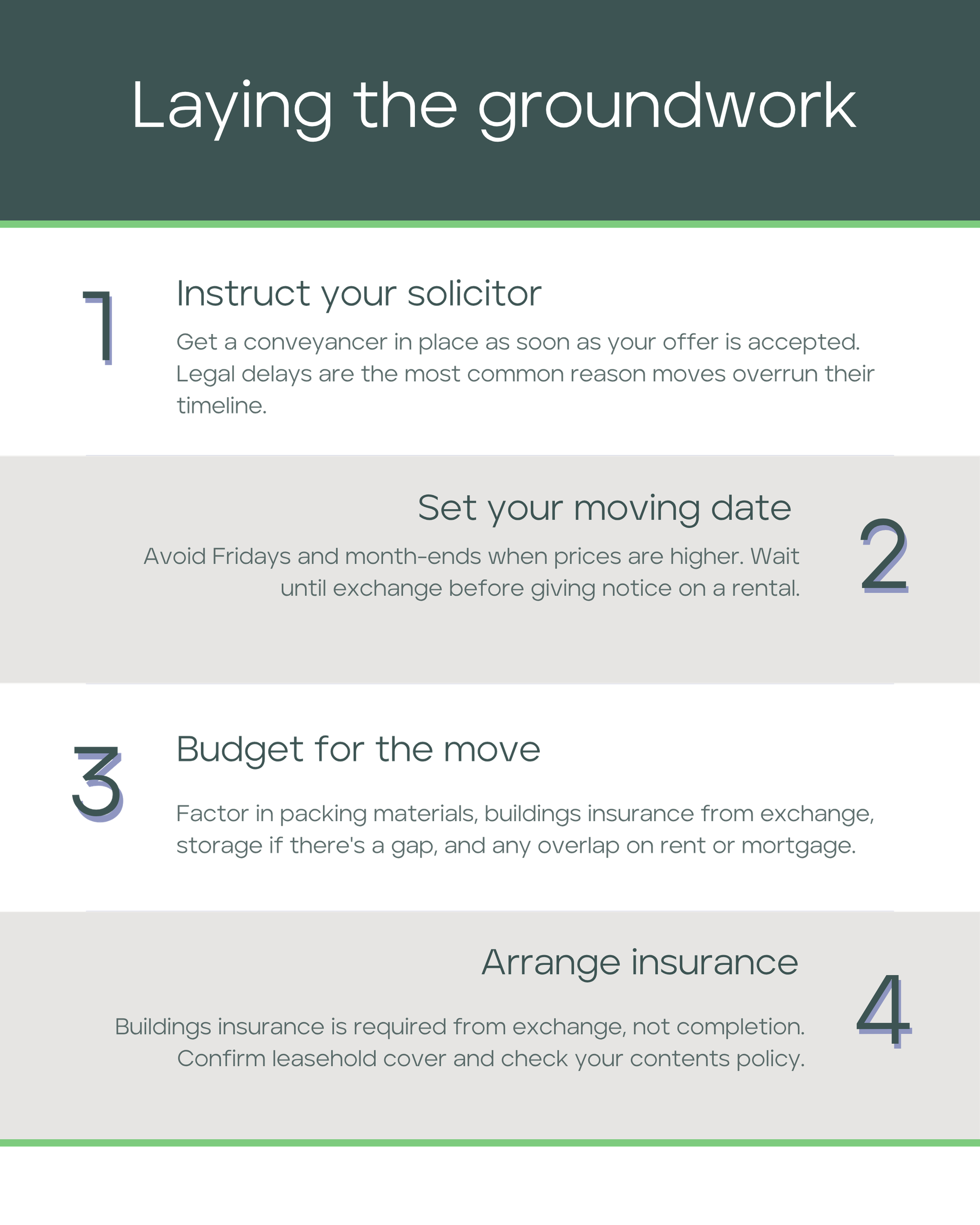
Most people start planning their move as soon as it becomes likely, even before dates are confirmed. Starting 8 to 12 weeks out gives you time to handle the things that can't be rushed.
Instruct a conveyancing solicitor
As soon as your offer is accepted, get a conveyancer in place. Legal delays are the most common reason house moves overrun their timeline, and instructing early means you're not scrambling when exchange approaches.
It's also worth creating a folder or binder at this stage to keep all your moving paperwork together: estimates, receipts, inventory lists, and contracts. Having everything in one place will save a lot of time as the moving date gets closer.
Set your moving date
Once you've exchanged contracts, you'll have a completion date to plan around. A few things worth considering:
- Avoid Fridays and end-of-month dates if you have any flexibility. These are the busiest days for removal companies and prices are higher across the board.
- School holidays are worth factoring in if you have children. Moving in the holidays gives them time to settle before starting at a new school.
- Confirm the date with your estate agent. If you're renting, check your tenancy agreement for the required notice period and hold off serving it until exchange is confirmed, not before.
Completion dates shift, sometimes by weeks, and handing your notice in too early can leave you in a genuinely difficult position. "Wait until you've exchanged," says Chris. "It's the one thing I'd tell every renting buyer."
Budget for the move
Removal costs vary considerably depending on the size of your home and the distance involved. Beyond the removals company, budget for:
- Packing materials: boxes, bubble wrap, packing tape, and bin bags
- Buildings insurance from the date of exchange (more on this below)
- Storage if there's a gap between leaving your old property and moving into your new one
- Any overlap on rent or mortgage if completion is delayed
Cost | Typical range |
|---|---|
Removal company: 1-bed flat | £400 to £500 |
Removal company: 2-bed property | £600 to £900 |
Removal company: 3-bed house | £900 to £1,400 |
Packing service (add-on) | £300 to £400 |
Parking suspension permit | £20 to £50 |
End of tenancy clean: 1-bed | £80 to £150 |
End of tenancy clean: 3-bed | £200 to £350 |
Royal Mail redirection (3 months) | Royal Mail redirection (3 months) |
Self storage during your move |
The hidden costs of moving are almost always the ones people leave until last. Parking suspensions, short-term storage, and cleaning requirements on rental properties can add several hundred pounds to a move that seemed straightforward on paper.
Arrange buildings and contents insurance
Buildings insurance is required from the moment you exchange contracts, not from completion. It covers the cost of repairing or rebuilding the structure of your home in case of major damage, so there shouldn't be any gap in cover between exchange and moving day.
If you're buying a leasehold flat in London, the picture is slightly different. Buildings insurance for the block is almost always handled by the freeholder or management company and recovered through the service charge.
"What buyers need to do is confirm it's actually in place before exchange," Chris told us. "I've seen people assume it's covered when it wasn't. Ask your solicitor for written confirmation, don't take it on trust."
Buying a flat? The insurance rules are different
If you're buying, it's also worth looking at Home Buyer's Protection Insurance. This covers you against financial loss if the purchase falls through before completion, including costs like conveyancing fees and survey costs. It's relatively low cost and offers useful protection during the uncertain period between offer and exchange.
Check your contents insurance policy too. Many policies are only valid during a move if it's carried out by a professional removals company rather than a DIY van hire. Worth confirming with your insurer before you book.
4 to 6 weeks before moving
Book your removals company
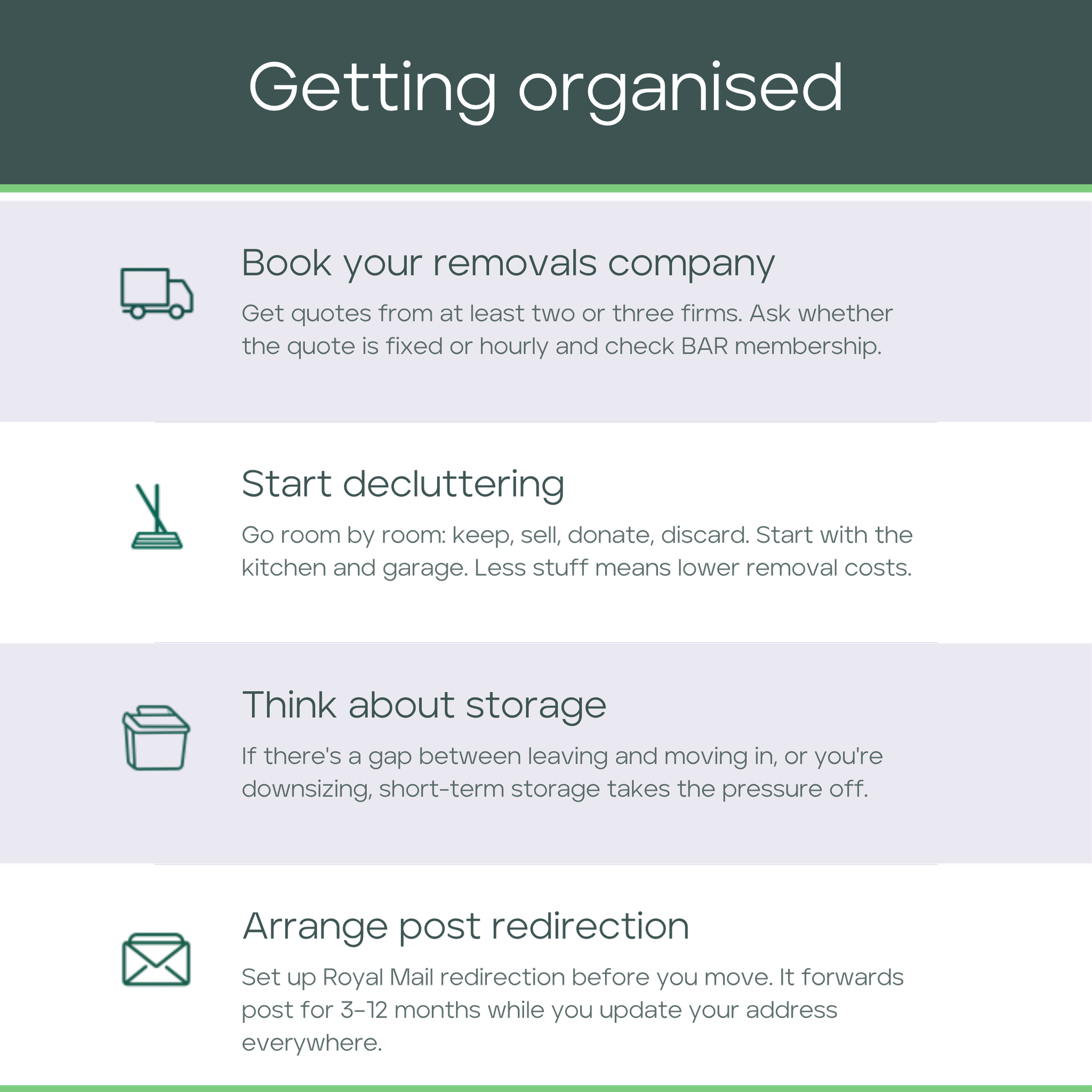
Hiring professional movers takes the logistics, packing, and heavy lifting off your plate entirely. Get quotes from at least two or three removal companies before committing. Before you sign anything, ask whether the quote is fixed or hourly.
"People fixate on the headline number, but it's the structure that matters," says Paul. "An hourly rate that looks fine at 9am can easily double by 3pm once you factor in parking delays, a slow lift, or a sofa that won't go round the stairs."
Don't leave booking late, especially for moves in London. Popular moving dates fill quickly and removal costs rise as availability drops. When comparing removal firms:
- Check whether they're a member of the British Association of Removers. BAR membership means they meet a recognised standard for insurance and conduct.
- Ask whether a packing service is available. It's worth considering for fragile items or if your schedule is tight in the weeks before the move. Confirm what their insurance covers, particularly for high-value items.
- If you're moving within London, ask about parking suspension requirements. Most London boroughs need advance notice to suspend bays outside your property for the removal van. A good removal firm will handle this, but make sure it's being done.
Start decluttering
The earlier you start decluttering, the less you'll pay to move, and the easier you'll find settling in at the other end. It helps to reframe the question: rather than asking "do I want this?", ask "is this worth paying to move, and worth finding a home for on the other side?"
Liz says most things that feel hard to let go of get considerably easier once you frame it that way. Go room by room and separate everything into four categories: keep, sell, donate, discard. Selling unwanted items online or donating to charity shops before the move is a straightforward way to reduce removal costs.
The kitchen and garage are typically the hardest rooms to clear. Start there.
Think about storage
If there's a gap between leaving your old property and moving into your new one, or if you're downsizing and not sure everything will fit, short-term storage takes the pressure off.
The gap between completing and actually moving in catches more buyers off guard than you'd expect. "You might get your keys on a Tuesday but the previous owner isn't out until Thursday," says Fred. "Having storage sorted in advance turns what would be a stressful scramble into something completely manageable."
HOLD offers flexible London storage with no fixed contracts. Free move-in van hire, 24-hour access, £2 rent for your first month, and a price match within 3 miles.
Arrange post redirection
Set up a Royal Mail redirection before you move. For a small fee, it'll forward your post from your old address to your new one for between three and twelve months. This gives you a buffer while you work through your full change of address notifications. Don't rely on the new occupants forwarding your mail.
2 to 3 weeks before moving
Start packing
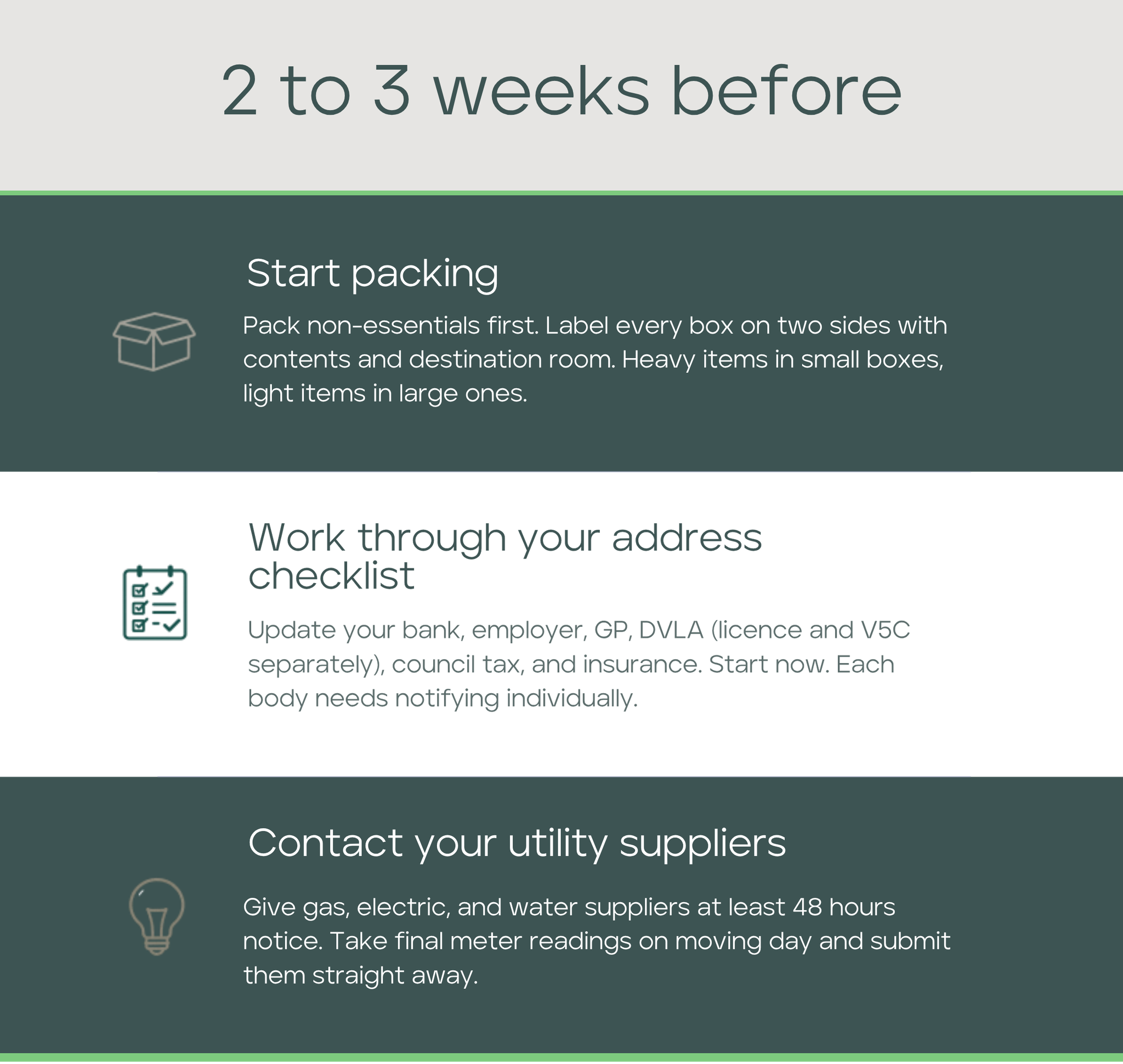
Start packing non-essential items at least two to three weeks before your moving date. A practical rule: if you won't need it in the next seven days, pack it now. Begin with seasonal clothing, books, ornaments, and spare linen.
Packing tips:
- Label every box with its contents and the destination room. Use waterproof markers and label at least two sides of each box.
- Pack heavier items in smaller packing boxes. Pack lighter, bulky items in larger ones.
- Wrap fragile items individually in bubble wrap or packing paper rather than grouping them loose.
- Pack your essentials box last and keep it separate from the removal van (more on this below).
Work through your change of address checklist
Your address checklist is one of the most time-consuming parts of moving house. Start it now rather than leaving it until after the move. Your bank, employer, GP, insurance providers, and subscription services are the most important to update first: these are the organisations most likely to send time-sensitive correspondence that you can't afford to miss.
Government and legal
HMRC
DVLA: your driving licence and your V5C vehicle log book are two separate processes. Missing the V5C is a common oversight.
Local council for council tax registration at your new address
Electoral roll
Passport (not urgent, but worth updating when you have time)
Each government body needs to be notified separately. The DVLA alone requires two separate updates: one for your driving licence and one for your V5C. Neither happens automatically when you notify HMRC.
Financial
Banks and building societies
Pension provider
Insurance providers: home, car, life, and health
Credit cards
If you have a workplace pension through an employer, your employer update may not carry it over. Check directly with your pension provider.
Utilities and services
Current utility suppliers: give at least 48 hours notice before your moving date
Internet providers and broadband providers
TV licence
Mobile phone provider
Check whether your broadband provider can actually transfer to your new address before you notify them. Some can't serve certain postcodes, and finding that out two weeks before moving gives you time to arrange an alternative without a gap.
Personal
GP: register with a new one if you're moving area
Employer
Online retailers and any subscription services
Schools, if applicable
If you're changing GP, ask your current surgery for a summary of your medical records before you leave rather than waiting for them to transfer automatically. It's faster and means your new GP has your history from day one.
Contact your utility suppliers
Give your gas, electricity, and water suppliers at least 48 hours notice before your moving date. Provide your new address and let them know when to issue your final bills. Take final meter readings on moving day and submit them immediately to avoid any disputes over charges after you've left.
The week before moving
Confirm everything with your removal team
A few days before the move, confirm:
- Arrival time and access at both properties
- Parking suspension status if you're in London
- Which items are going into storage versus directly to the new property
- Your mobile phone number so the removal team can reach you easily
Paul stresses the importance of confirming who's actually leading the crew. "The person you booked with isn't always the one who turns up," he told us. "Make sure whoever's running the job has seen the notes."
Pack your essentials box
Pack one box or bag that travels with you separately from the removal van. It should contain everything you'll need for the first 24 hours in your new home, without opening a single box from the van.
The non-negotiables are cleaning supplies, a kettle, and toiletries, but a full kit covers:
- Bedding and towels
- Toiletries, medications, and any important documents
- Phone charger and laptop
- Kettle, mugs, and tea or coffee
- Cleaning products and bin bags
- A change of clothes for everyone in the household
- Pet food, bowls, and any pet medications
- Children's comfort items if needed
Label it clearly. You won't want to open forty boxes at 9pm to find the toilet roll.
Moving day
Take final meter readings
Before you leave your old property, take final meter readings for gas and electricity. Photograph the meters for your records and submit the readings to your utility suppliers the same day. Before you close the door for the last time, make sure all utilities are turned off: check taps, gas, and any appliances left behind.
Do a full walk-through
Fred's observation is that the loft and garage are where moving days fall apart. "People leave them until last and then realise at 7am that they've got twice as much stuff as they thought," he told us. "It's almost always where the extra hour comes from." Before the removal team leaves, go through everything:
- Check every room, cupboard, loft, and outbuilding
- Check the garden and any external storage
- Collect all the keys: front door, back door, garage, any spare keys
- Leave details for the new occupants: location of the fuse box, stopcock, boiler, gas and electricity meters, and any appliance instructions
Hand over the keys
If you're selling, your solicitor will confirm when to hand over the keys. If you're renting, agree a handover time with your landlord and make sure the property's cleaned to the standard your tenancy agreement specifies.
In your new home
Record meter readings on arrival
Take meter readings for gas and electricity as soon as you arrive. Submit them to your new utility suppliers straight away to establish your baseline and avoid being billed for the previous occupant's usage.
Check the basics
Before the removal team leaves the new property:
- Locate the fuse box, stopcock, and boiler
- Test the central heating and hot water
- Check that all keys work, including any spare set
- Confirm where the gas and electricity meters are
Consider changing the locks
You don't know how many spare keys the previous owners handed out. Changing the locks shortly after moving in is a straightforward step that gives you peace of mind from day one.
Your settling-in checklist
Register for council tax at your new address
Confirm you're on the electoral roll
Update your TV licence
Update your home insurance with the new address
Register with a local GP if you've moved area
Start unpacking essentials first: kitchen, bathroom, bedrooms
Good luck with your move!
Moving house rarely goes exactly to plan, especially in London. But working through it stage by stage makes it a lot more manageable. From the customers we see at HOLD, the ones who find moving day least stressful almost always started planning earlier than felt necessary.
Trust us, nobody has ever looked back on a house move and thought they packed too early. Eight weeks may feel like a long time until exchange is confirmed and the clock starts.
If you're at the beginning of the process, now is the right time. Not when moving day is three weeks away.

Ready to move? Here's how HOLD can help
- £2 for your first month
- Free move-in van hire
- 24-hour access comes as standard
- No long-term contracts
- Individually alarmed units with 24/7 CCTV
- Price match within 3 miles
When you're in the middle of a house move, the last thing you need is more to worry about. HOLD gives you the flexibility to move at your own pace, with storage you can access any time and no pressure on timing.